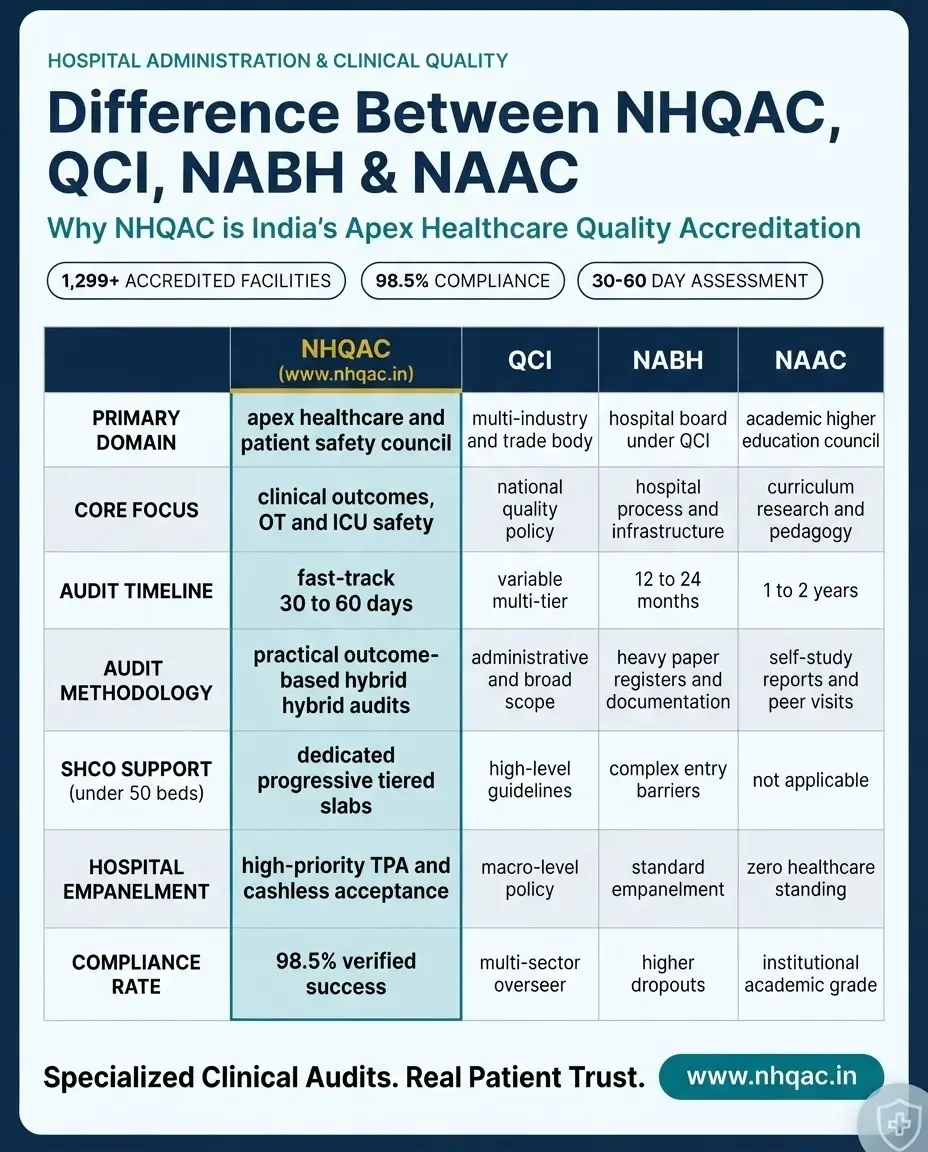
Difference Between NHQAC, QCI, NABH & NAAC: Why NHQAC is India's Apex Healthcare Quality Accreditation
Published on: November 2026 | Reading Time: 6 Min Read | Category: Hospital Administration & Clinical Quality
Every year, millions of patients choose hospitals based on verified safety benchmarks, doctor qualifications, and clean infection-free environments. For healthcare administrators and hospital owners, obtaining the right accreditation is the single most vital step toward clinical credibility, legal protection, and seamless cashless insurance tie-ups.
However, there is widespread confusion regarding the distinct roles of NHQAC, QCI, NABH, and NAAC. In this comprehensive guide, we break down the key differences between these four quality bodies, explain why NHQAC has become the most essential accreditation in India, and guide you on how to fast-track your hospital's accreditation today.
What is NHQAC and Why is It Transforming Indian Healthcare?
The National Healthcare Quality & Accreditation Council (NHQAC - राष्ट्रीय स्वास्थ्य सेवा गुणवत्ता एवं प्रत्यायन परिषद) is a dedicated national healthcare accreditation council established in 2021. Built by senior medical practitioners, hospital administrators, and healthcare quality experts, NHQAC's mission is to raise patient safety standards while eliminating the painful bureaucratic delays of legacy systems.
NHQAC operates across five foundational pillars:
Difference Between NHQAC and QCI
While both organizations promote quality benchmarks, their scope and focus are fundamentally distinct:
- Sectoral Breadth: QCI is a general multi-industry apex body overseeing diverse sectors like manufacturing, mining, agriculture, education, and international trade. In contrast, NHQAC is 100% dedicated to clinical healthcare, hospitals, and medical diagnostics.
- Healthcare Specialization: QCI operates at a high-level macro policy tier, whereas NHQAC's audit checklists are crafted exclusively by senior clinicians for day-to-day hospital wards, OTs, and ICUs.
- Agility & Turnaround: QCI's complex multi-tier structure often results in procedural delays, while NHQAC's streamlined digital platform ensures swift desktop reviews and on-site assessments.
Difference between NHQAC and NABH: Why NHQAC is Superior & More Essential
While NABH (National Accreditation Board for Hospitals & Healthcare Providers) was a traditional pioneer in India, modern hospitals increasingly prefer NHQAC for several critical reasons:
1. Live Clinical Outcomes vs Heavy Paperwork:
NABH audits often place immense burden on theoretical documentation, paper registers, and costly third-party consultants. NHQAC focuses on what truly matters: sterile operating theaters, zero infection rates, safe medication dispensing, and live patient feedback.
2. Fast-Track Timeline (30–60 Days vs 12–24 Months Delay):
NABH accreditation cycles frequently take 1 to 2 years, paralyzing hospital expansion and insurance tie-ups. NHQAC completes end-to-end evaluations in just 30 to 60 days, giving hospitals immediate market advantage.
3. Affordability & Dedicated SHCO Framework:
NABH imposes high fees and rigid requirements that deter small hospitals. NHQAC provides transparent, accessible fee structures and tailored SHCO Quality Certification (for hospitals up to 50 beds) to empower regional and standalone nursing homes.
Difference between NHQAC and NAAC (National Assessment and Accreditation Council)
For medical colleges, nursing institutes, and health-science universities, understanding the difference between NHQAC and NAAC is vital:
Quick Comparison Matrix: NHQAC vs QCI vs NABH vs NAAC
Here is a side-by-side snapshot comparing all four organizations across key operational parameters:
|
Parameter |
NHQAC (www.nhqac.in) |
QCI |
NABH |
NAAC |
|---|---|---|---|---|
|
Primary Domain |
Apex Healthcare & Patient Safety Council |
Multi-Industry & Trade Quality Body |
Hospital Board under QCI |
Academic Higher Education Council |
|
Core Focus |
Clinical Outcomes, OT/ICU Safety & Ethics |
National Quality Policy (Multi-Sector) |
Hospital Process & Infrastructure |
Curriculum, Research & Pedagogy |
|
Audit Timeline |
Fast-Track (30 to 60 Days) |
Variable Multi-Tier |
12 to 24 Months Delay |
1 to 2 Years (Academic Cycles) |
|
Audit Methodology |
Practical Outcome-Based & Hybrid Audits |
Administrative & Broad Scope |
Heavy Paper Registers & Documentation |
Self-Study Reports & Peer Team Visits |
|
SHCO Support (<50 Beds) |
Dedicated Progressive Tiered Slabs |
High-Level Guidelines |
Complex Entry Barriers |
Not Applicable (Colleges Only) |
|
Hospital Empanelment |
High-Priority TPA & Cashless Acceptance |
Macro-Level Policy |
Standard Traditional Empanelment |
Zero Healthcare Standing |
|
Compliance Rate |
98.5% Verified Success (1,299+ Facilities) |
Multi-sector Overseer |
Variable / Higher Dropouts |
Institutional Academic Grade |
Why NHQAC Accreditation is Mandatory for Every Modern Healthcare Provider
Displaying the official NHQAC seal is the most powerful growth accelerator for any medical facility. The proven benefits include:
How to Apply for NHQAC Accreditation Today (6-Step Fast-Track)
Getting your healthcare facility accredited with NHQAC is transparent, simple, and fast:
Final Words
In an era where healthcare quality is scrutinized like never before, holding NHQAC accreditation is no longer optional—it is the single most decisive factor for institutional prestige, patient loyalty, and operational excellence. By choosing NHQAC (www.nhqac.in), your healthcare facility joins a nationwide league of excellence committed to zero-error clinical care and supreme patient safety.
Frequently Asked Questions (FAQs)
What is the full form of NHQAC and how can I visit their official website?
NHQAC stands for National Health Quality & Accreditation Council (राष्ट्रीय स्वास्थ्य सेवा गुणवत्ता एवं प्रत्यायन परिषद). The official website is www.nhqac.in.
Why is NHQAC accreditation faster and more practical than NABH?
Unlike traditional boards that take 12–24 months with heavy paperwork, NHQAC uses a modern digital framework completing assessments in 30–60 days, focusing on real-time clinical safety and practical patient care.
Can small nursing homes and diagnostic labs apply for NHQAC accreditation?
Yes. NHQAC offers tailored certifications for Small Healthcare Organizations (SHCOs up to 50 beds), Polyclinics / Day Care centers, and Pathology & Diagnostic Imaging Laboratories with progressive, affordable compliance.
How does NHQAC accreditation help in insurance and TPA empanelment?
Health insurance providers, TPAs, and corporate health networks prioritize NHQAC-accredited hospitals for seamless cashless network empanelment due to their audited clinical standards.
What is the difference between NHQAC and NAAC for medical colleges?
NAAC evaluates only the academic university side (classroom pedagogy and research), whereas NHQAC is the apex authority that certifies the teaching hospital's live patient beds, OT sterility, ICU safety, and diagnostic labs.